what happened to the orcs after sauron dies
- "Tolkien creates them to represent all that is bad about mod war."
- —Lynette Nusbacher in The Story of J.R.R. Tolkien: Master of the Rings
Orcs were the primary foot soldiers of the Dark Lord's armies and sometimes the weakest (but most numerous) of their servants. They were created by the first Dark Lord, Morgoth, before the Showtime Age and served him and after his successor in their quest to dominate Middle-earth. Before Oromë outset found the Elves at Cuiviénen, Melkor kidnapped some of them and cruelly deformed them, twisting them into the first Orcs.[1]
Afterward the War for Sake of the Elves many Orcs (along with fallen Maiar and other evil servants of Melkor) survived in the deep caves, pits, chambers, and tunnels of Melkor's underground fortress Angband. They multiplied and later spread through northern Middle-earth. They were first seen by the Dwarves who reported them to Thingol, King of Doriath, causing the latter to seek weapons of war for the outset time.[2] For over a millennium, the Orcs were but a minor problem, but when Melkor (Morgoth) returned with the Silmarils he took full charge of them and before long unleashed them on Beleriand. The newly organized Orcs killed Denethor, the King of the lightly armed Laiquendi, but were eventually defeated by Thingol and his allies. They besieged the Havens of the Falas nether Círdan, and the siege wasn't broken until the arrival of the Ñoldor. The heavy losses that the Sindar suffered at the hands of the Orcs frightened them to the signal that Melian, Queen of Doriath raised a great enchantment to protect their kingdom. The Laiquendi, who suffered the most in the boxing, hid themselves in Ossiriand under the cloak of secrecy, or took refuge in Doriath.
Contents
- one History
- 1.1 Before the Get-go Historic period
- ane.ii First Historic period
- 1.3 Second Age
- ane.4 Third Historic period
- 2 Characteristics
- 3 Etymology
- 3.1 Other names
- 4 Notable Orcs
- 5 Portrayal in adaptations
- five.1 The Lord of the Rings (1978 animated picture)
- 5.two The Return of the Male monarch (1980 animated picture)
- five.3 Peter Jackson's films
- half-dozen Quotes virtually Orcs
- 7 Gallery
- 8 Translations
- 9 References
History
- "They were elves once, taken past the dark powers, tortured and mutilated, a terrible, ruined form of life..."
- —Saruman
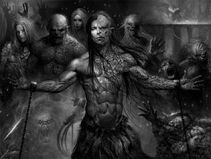
Orcs were first created from Elves nether torture and dark sorcery. Their cosmos served as an insult to the Children of Ilúvatar.
Before the Starting time Age
Melkor was the first to larn of the Awakening of the Elves. He presently began sending evil spirits among the Elves, who planted seeds of doubt confronting the Valar. Information technology is also rumoured that some of the Elves were beingness captured by a "Rider" (Oromë) if they strayed too far, and it was believed these unfortunate elves were brought to Utumno, where they were cruelly tortured and twisted into Orcs.
Kickoff Age
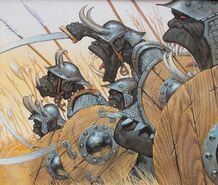
Orcs served nether Morgoth in the Commencement Age and Sauron in the Second and Third Ages.
In the First Age, thousands of Orcs were bred in Angband by Morgoth and to participate in the Battles of Beleriand, which lasted 587 years. They start appeared in the Battle of the Lammoth, where they were defeated by the Ñoldor. When the House of Fëanor returned to Middle-earth Morgoth sent a strength of Orcs confronting them. Although the Orcs outnumbered the exiles they were no match for the power and wrath of the Ñoldor, and were quickly and easily defeated. Even so, Fëanor could non defeat the ability of Morgoth alone and he was killed by Balrogs, leaving the Orcs to continue to breed under the Dark Lord. Years later, when the House of Fingolfin arrived in Middle-earth, Orcs were sent against them as well, but they were utterly defeated in the Battle of the Lammoth.
After their crushing defeat in the Dagor Aglareb and in a modest raid on Hithlum, the Orcs nevertheless regained their numbers. In the Dagor Bragollach and Nírnaeth Arnoediad, they and their master won crushing victories against the costless peoples. Even so, they were almost destroyed in the War of Wrath, and those that survived fled eastwards into the Mountains of Angmar, the Grayness Mountains and the Orocarni.
Second Age
Sometime around SA chiliad, Sauron reappeared in Middle-earth and made the land of Mordor his realm, and so started to build the foundations of Barad-dûr. During the War of the Elves and Sauron in SA 1700, the Orcs formed the main host of Sauron's ability. Despite the immeasurable number of Orcs present, the battle was won by the Elves and the Númenóreans due to their united force, superior weaponry, greater force and stature and gainsay skill.
However Sauron had not been able to assemble all the Eastern Orcs into his armies, as they at starting time scorned him, not realising the off-white 'Annatar' was Sauron. It was only after his first defeat that Sauron went amongst them in dark guise and was thus able to begin rebuilding his power.
Until Sauron's final downfall in the Tertiary Historic period, Orcs remained the backbone of the armies of Mordor, and of Isengard when Saruman ruled information technology.
Third Historic period
Later on the War of the Last Brotherhood Mordor was desolate and the surviving Orcs were concentrated in the Misty Mountains. With the return of Sauron to Dol Guldur and the spread of his evil influence, their numbers began to increase over again. In TA 2475 at the ending of the Watchful Peace, a new tougher, stronger breed of Orc appeared; the Black Uruks, specifically bred for fighting Men.
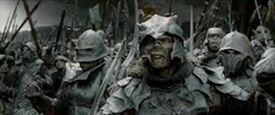
Orcs of Mordor in Peter Jackson'southward The Lord of the Rings films
Following the abandonment of Khazad-dûm by the Dwarves, Orcs eventually colonised the abandoned halls, killing King Thrór when he sought to enter his lost realm. This triggered the State of war of the Dwarves and Orcs, a massive disharmonize where the Dwarves gathered their full force and destroyed every Orc stronghold they could discover in the Misty Mountains. This and the Battle of V Armies greatly reduced the numbers of Northern Orcs, weakening their contribution to the War of the Ring.
In the meantime Sauron had returned to Mordor, rebuilding his fortress and creating a vast army of Orcs. His thrall Saruman too created the Uruk-hai, a breed of Orc stronger than whatever seen before. Following the destruction of the One Ring, the Orcs scattered, eventually dwindling and being hunted to extinction in the Fourth Historic period.
Characteristics
- "For all that race were bred by Melkor of the subterranean heats and slime. Their hearts were of granite and their bodies deformed; foul their faces which smiled not, but their express joy that of the disharmonism of metal, and to zip were they more fain than to assistance in the basest of the purposes of Melko."
- —The Autumn of Gondolin
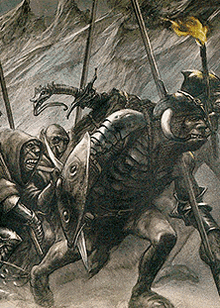
Orcs of Mordor every bit depicted by John Howe
In J.R.R. Tolkien's writings, Orcs were cruel, sadistic, black-hearted, vicious, and mean of everybody and everything, particularly the orderly and prosperous.[3] Physically, they were curt in stature (unless of the Uruk variety) and humanoid in shape. They were generally squat, broad, apartment-nosed, sallow-skinned, bow-legged, with wide mouths and camber eyes, long arms, dark pare, and fangs. Tolkien describes one "huge Orc chieftain" as "about Man-high", and some must have been shut to Hobbit acme, as Sam and Frodo were able to disguise themselves every bit Orcs in Mordor. They were roughly humanoid in shape with pointed ears, sharpened teeth and grimy skin. Their appearance was considered revolting by virtually of the other races.
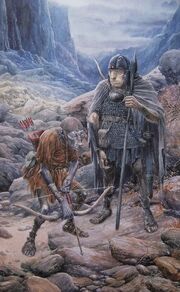
Orcs fabricated no beautiful things, but many clever ones including machines, tools, weapons, and instruments of torture. They were delighted by wheels, engines, and explosions, and could tunnel and mine as well as whatsoever but the most skilled Dwarves, though they are often untidy and dingy.[3] This was and then since the fourth dimension Melkor bred them (in an unknown process) from mutilated and corrupted Elves. They hated themselves, and had an even deeper secret hatred for Melkor, thus resulting as a violent and warlike race in a perpetual state of chaos with itself and others. Despite their beastly nature, Orcs were often crafty and clever rather than dim-witted. Tolkien writes that they were capable smiths and craftsmen, though things of their making are described every bit crude compared to those of the Costless Peoples. Orcs as well developed tunnel-making, and then as to dwell underground away from the light. It is besides worth noting that Orcs prefer to do no more work than they tin can help, every bit they would rather coerce others into working for them.[4]
Wickedness and violence were their nature, and it was not uncommon for them to kill each other in piddling quarrels.[5] They had a subversive outcome on nature, especially forests, and often destroyed trees to fuel their war-making, peculiarly those near Isengard. Orcs had unchangeable disdain for all Elves, Dwarves, and Men, though they fought aslope wicked men under Morgoth and then Sauron in the First and 3rd Age and were besides said to have made alliances with wicked Dwarves.
Etymology
In Tolkien's Sindarin language, Orc is orch, plural yrch. In his late, post-Lord of the Rings writings (published in The Peoples of Middle-earth), he preferred the spelling "Ork", evidently mainly to avoid the course Orcish, which would exist naturally pronounced with the c equally /s/ instead of /1000/. (In Tolkien'southward languages the letter c was always pronounced /k/.) It is also possible that the word is a Common Tongue Version of 'orch', the Sindarin word for Orc. The original sense of the word seems to be "bogey", "apparition", that is, something that provokes fearfulness, as seen in the Quenya cognate urko, pl. urqui. In the sometime English Orc ways "demon."[half dozen] The term Uruk-hai merely means "orc-folk" in the Blackness Speech, and was the Uruk-hai's name for themselves.
Other names
Glamhoth was a Sindarin word for the Orcs that meant 'din-horde'.[vii]
Gorgûn was the name that the wild men of the Drúadan Forest used for Orcs in their own language.
Yrch was the term used past Haldir and his brothers, who were Elves of Lothlórien. This aforementioned word was also used by Legolas, indicating that it was either Sindarin or Silvan Elvish in origin.
Notable Orcs
- Azog
- Bolg
- Golfimbul
- Gorbag
- Grishnákh
- Shagrat
- Snaga
- Uglúk
Portrayal in adaptations
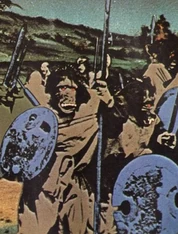
Orcs (1978)
The Lord of the Rings (1978 blithe movie)
In The Lord of the Rings (1978), the Orcs are voiced by extras.
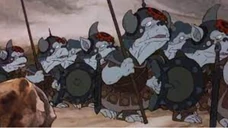
Orcs (1980)
The Return of the King (1980 animated film)
In The Return of the Rex (1980), the Orcs are voiced by Paul Frees.
Peter Jackson'south films
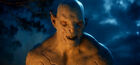
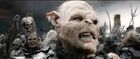
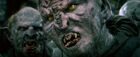
In Peter Jackson'due south two film trilogies, Orcs range profoundly in advent. Skin color ranges from bone white (Azog and Bolg) to nifty colours (Orcs like the lieutenant Gothmog in The Return of the King), to shades of greenish. Most Orcs however are shown as having darker shades of blackness or brown peel. Some are more human being-like than others; Azog looks like a big and muscular but stake and hairless human, whilst Gothmog has a very deformed confront. In general the Orcs tend to be shorter than most men. Some orcs shown are particularly slack with poor posture and broad with long artillery, a shape represented best in Grishnákh's portrayal in The Two Towers; others, such as all Uruks, have a human posture. A new rendition of Orcs was introduced in The Hobbit: An Unexpected Journeying: short mutated creatures covered in dubious warts and unidentified growths. They have pallid pink-white pare, large heads, and bat-like or porcine facial features.
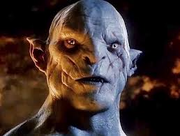
Azog the Defiler in The Hobbit: An Unexpected Journey
The clothing and armour worn past Orcs in the films vary greatly. The Orcs habiliment an assortment of different styles of armour and clothing and as well usually take various piercings and tribal scars. Other Orcs wear specifically designed and fabricated uniform armour for battle. They are often bald or are balding, while others accept long, coarse hair. Their hair is most often nighttime or greying in colour, but in The Return of the Male monarch some Orcs with blond hair and beards are seen marching from Minas Morgul.
Quotes about Orcs
- "But of those unhappy ones [elves] who were ensnared past Melkor little is known of a certainty. For who of the living has descended into the pits of Utumno, or has explored the darkness of the counsels of Melkor? Yet this is held true by the wise of Eressëa, that all those of the Quendi who came into the hands of Melkor, ere Utumno was broken, were put there in prison, and by slow arts of cruelty were corrupted and enslaved; and thus did Melkor breed the hideous race of the Orcs in envy and mockery of the Elves, of whom they were later the bitterest foes. For the Orcs had life and multiplied after the manner of the Children of Ilúvatar; and naught that had life of its own, nor the semblance of life, could always Melkor make since his rebellion in the Ainulindalë before the Beginning: so say the wise. And deep in their dark hearts the Orcs loathed the Principal whom they served in fear, the maker just of their misery. This information technology may be was the vilest human action of Melkor, and the well-nigh hateful to Ilúvatar."
- —J. R. R. Tolkien, The Silmarillion, Of the Coming of the Elves and the Captivity of Melkor
- "And ere long the evil creatures came even to Beleriand, over passes in the mountains, or upward from the due south through the dark forests. Wolves there were, or creatures that walked in wolf-shapes, and other vicious beings of shadow; and among them were the Orcs, who subsequently wrought ruin in Beleriand: simply they were still few and wary, and did merely olfactory property out the means of the land, awaiting the return of their lord. Whence they came, or what they were, the Elves knew not then, thinking them perhaps to be Avari who had get evil and barbarous in the wild; in which they guessed all too near, it is said."
- —J. R. R. Tolkien, The Silmarillion, Of the Sindar
Gallery
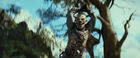
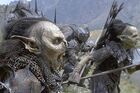
Orcs Azog in The Hobbit film trilogy Bolg in The Hobbit picture show trilogy Orcs Orcs of the Misty Mountains Gothmog in The Lord of the Rings film trilogy Orcs as portrayed by illustrator Alan Lee 


Translations
| Foreign Language | Translated name |
| Amharic | ዖርችስ |
| Arabic | الأورك |
| Armenian | Ործս |
| Basque | Orkora |
| Belarusian Cyrillic | Оркі |
| Bengali | ওর্চ্স |
| Bosnian | Orci |
| Bulgarian Cyrillic | Орките |
| Chinese | 兽人(Lucifer Chu Edition) /奥克(Deng Jiawan Edition) |
| Croatian | Orci |
| Czech | Skřeti |
| Danish | Orker |
| Dutch | Orks |
| Esperanto | Orko |
| Finnish | Örkit |
| French | Orques |
| Galician | Orco |
| Georgian | ორკები |
| German | Orks |
| Greek | Ορκς |
| Gujarati | ઑર્ચ્સ |
| Hebrew | אורקים |
| Hindi | ॐर्च्स |
| Hungarian | Orkok |
| Icelandic | Orkar |
| Italian | Orchi |
| Japanese | オーク |
| Kannada | ಓರ್ಕ್ಸ್ |
| Kazakh Cyrillic | Орцс |
| Korean | 오크 |
| Kyrgyz Cyrillic | Орцс |
| Laotian | ອrຈຊ ? |
| Latvian | Orks |
| Lithuanian | Orkai |
| Macedonian Cyrillic | Орци |
| Marathi | ॐर्च्स |
| Mongolian Cyrillic | Орцс |
| Nepalese | ॐर्च्स |
| Norwegian | Orker |
| Pashto | ورچس |
| Persian | اورک |
| Shine | Orkowie |
| Romanian | Orcii |
| Russian | Орки |
| Sanskrit | ॐर्च्स् |
| Serbian | Оркови (Cyrillic) Orkovi (Latin) |
| Sinhalese | ඕර්ච්ස් |
| Slovak | Ohyzdi |
| Slovenian | Orki |
| Spanish | Orco |
| Swedish | Orcherna |
| Tajik Cyrillic | Орчс |
| Tamil | ஓகர்ஸ் |
| Telugu | ఓర్చ్స |
| Thai | ออร์ค |
| Turkish | Orklar |
| Ukrainian Cyrillic | Орки |
| Urdu | ورچس |
| Uzbek | Орчс (Cyrillic) Orchs (Latin) |
| Welsh | Orchod |
| Yiddish | ױרשס |
References
- ↑ The Silmarillion: Quenta Silmarillion, "Of the Coming of the Elves and the Captivity of Melkor"
- ↑ The Silmarillion, Quenta Silmarillion, "Of the Sindar"
- ↑ 3.0 three.i The Hobbit, Chapter IV: "Over Loma and Nether Hill
- ↑ The Hobbit, Chapter IV: Over Hill and Under Colina
- ↑ The Lord of the Rings, The Render of the King, Book Six, Ch. Two: "The Land of Shadow"
- ↑ The Consummate Guide to Middle-earth
- ↑ Unfinished Tales, Part Ane: The Starting time Age: "Of Tuor and his Coming to Gondolin"
Source: https://lotr.fandom.com/wiki/Orcs
0 Response to "what happened to the orcs after sauron dies"
Postar um comentário